Holiday cards and year-end print on 100% recycled paper.Request a quote →

Call GregRequest a quote

Eco questions

Straight answers about printing on recycled paper

Answers to common questions about certifications, inks, minimums, pricing and timing for eco-friendly printing. If your question is not listed here, please give us a call.

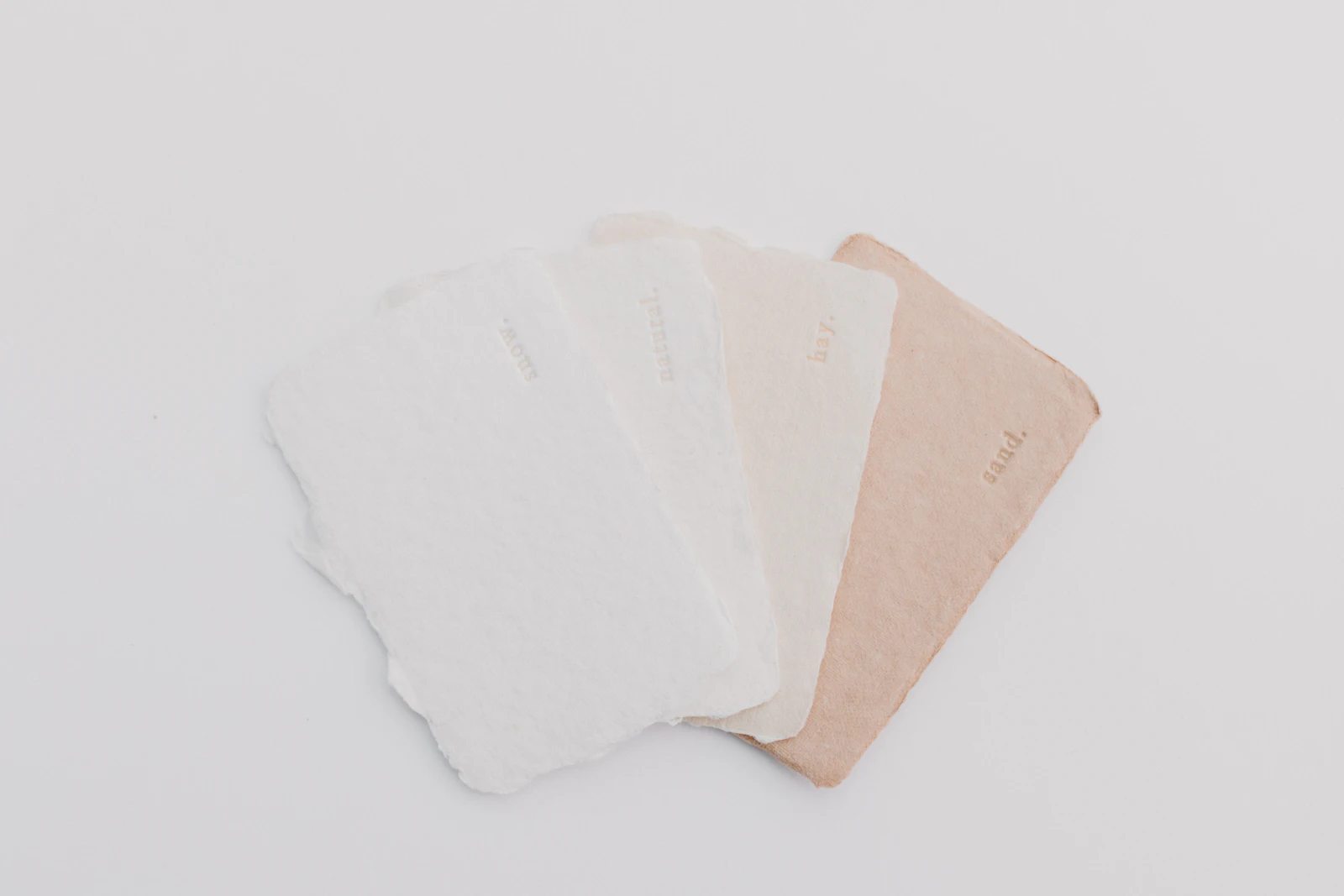
Sheets of handmade recycled paper in white and natural shades
01
The questions

All questions

Sustainability

Sustainability

What is eco-friendly printing?

Eco-friendly printing means choosing materials and processes that take less out of the environment than conventional printing does: recycled and responsibly forested fiber instead of virgin pulp, vegetable- and soy-based inks instead of petroleum-based ones, and chlorine-free bleaching instead of elemental chlorine.

It also means printing the right quantity on the right stock, so less of the job ends up in a recycling bin six months later. Every job we run uses recycled, FSC-certified paper, soy-based inks and chlorine-free processing as the default, not as a paid upgrade you have to know to ask for.

Link to this answer

Sustainability

Sustainability

Why choose eco-friendly printing?

Three reasons come up most often.

The environmental one. Recycled fiber keeps paper out of landfill and takes less energy and water to produce than virgin pulp. Soy inks avoid the volatile organic compounds that come with petroleum-based ink, and they release more cleanly during recycling, so the sheet comes back as better fiber.

The commercial one. Customers, procurement teams and grant committees increasingly ask what your printed materials are made of. An FSC-certified recycled stock is an answer you can put in writing, with documentation behind it.

The practical one. It costs less than most people expect. Recycled stocks are competitive with virgin paper, and we will let you know when a spec adds cost without an environmental benefit.

Link to this answer

Sustainability

Sustainability

How do I stop wasting paper?

The biggest source of waste we see is over-ordering, not the press itself. A customer prints five thousand brochures because the unit price looked better at that quantity, then throws away three thousand when the phone number changes.

These four steps help:

• Order the quantity you will use during the time the information on the page stays current.

• Proof carefully, so you do not need to reprint the whole run because of a typo.

• Design to standard sheet sizes, so less of the parent sheet is trimmed off and thrown away.

• Pick a stock and finish that stay recyclable. Some laminates and foils can keep an otherwise recyclable sheet out of the recycling stream.

Link to this answer

Sustainability

Sustainability

Where can I learn more about sustainable printing?

Our blog covers paper stocks, certifications, ink chemistry and the practical side of specifying greener print. The articles cover the same advice we give customers on the phone.

Ask about paper samples when you request a quote.

Link to this answer

Materials & Paper

Materials & Paper

How do you ensure the sustainability of your products?

It starts with the paper. We buy from mills whose recycled content and chain of custody we can document (Sustana, Monadnock, Neenah and Mohawk among them), and the stock we print on is FSC-certified.

Bleaching is chlorine-free, which avoids the dioxin by-products associated with elemental chlorine. Inks are soy- and vegetable-based rather than petroleum-based. We also help you order the quantity you will use, which reduces waste.

If you need certification details or a mill spec sheet for a client, an RFP or a grant application, ask and we will supply them.

Link to this answer

Materials & Paper

Materials & Paper

Can I see the paper before I commit?

Recycled stocks vary more in texture, shade and opacity than virgin paper does, and a screen will not show you any of that.

The paper stocks page lists the mill, the recycled content and the certifications for each sheet we run most. If the feel of the stock is important to the job, mention it when you ask for a quote and we will help you choose the stock that suits it.

Link to this answer

Inks & Process

Inks & Process

Is soy ink more environmental than non-toxic toner?

Each one suits different jobs, so the answer depends on what you are printing.

Soy and vegetable inks are made from a renewable crop rather than petroleum, release far fewer volatile organic compounds, and, importantly, they de-ink more cleanly at the recycling mill, so the paper they were printed on comes back as better recycled fiber.

Non-toxic toners avoid solvents too, and they suit very short digital runs where the setup cost of an offset job is not worthwhile. For most of our offset work, soy ink is the better choice. For a run of fifty pieces, digital toner may be the better choice. We will recommend the option that suits your job.

Link to this answer

Inks & Process

Inks & Process

Do you need special equipment to print environmentally?

No. Recycled paper runs on the same offset and digital presses as virgin paper, and soy-based inks run on the same units as petroleum inks.

What changes is sourcing and experience. A printer needs to know which recycled stocks hold a solid without mottling, how soy inks behave on an uncoated sheet, and which coatings are compostable. We have decades of experience buying and running these materials.

Link to this answer

Certifications

Certifications

What does FSC certified mean?

FSC stands for Forest Stewardship Council. It is an independent certification that tracks fiber from the forest through every company that handles it, a chain of custody, so a certified sheet can be traced back to forests managed to standards covering replanting, biodiversity, water, and the rights of workers and local communities.

The certification follows the paper through the mill, the merchant and the printer. To carry the FSC logo, a printed piece has to be produced by a printer with chain of custody certification, or through a certified partner. Ask which certified stocks suit your job when you request a quote, and we will confirm what can appear on the finished piece. Our guide to what FSC certified means covers the labels in more detail.

Link to this answer

Working With Us

Working With Us

What products do you offer?

We offer around two dozen product lines, including business cards, brochures, flyers, posters, coasters, banners, signage, packaging, invitations, notebooks and full book publishing. We also take on custom work that does not fit a single category.

Every one of them is printed on recycled, FSC-certified stock. You can browse the full catalog, with sizes, stocks and minimums, on the products page. If you do not see what you need there, contact us, since most of what we print is custom.

Link to this answer

Working With Us

Working With Us

Do you print custom sizes and formats?

Yes. The sizes listed on each product page are the ones we run most often, not a fixed menu. Size, stock, ink, finish, folding and binding are all open, and unusual formats are a large part of what we do.

Tell us what you have in mind, and we will explain what it takes to produce it, what it will cost, and whether a simpler spec could give you a similar result at a lower price.

Link to this answer

Working With Us

Working With Us

What artwork do you need from me?

A press-ready PDF with fonts embedded and images at 300 dpi is the easiest file for us to work with.

If you have a Canva link, a Word file, an old business card or a rough sketch instead, mention it when you request a quote. Design help is part of what we do, and it costs less to fix a file before the job is priced than after it is on press.

Link to this answer

Working With Us

Working With Us

Do you work with clients outside Florida?

Yes. We are based in Ponte Vedra Beach, Florida, and we print for clients across the country. The business started in Northport, New York in 1990 and we still print for Long Island clients. Most of the relationship happens by phone and email, and finished work ships to you.

If you are outside the United States, contact us before you plan your job. International shipping is possible on some jobs, and we can discuss cost and timing with you before the job begins.

Link to this answer

Working With Us

Working With Us

Why should I use you over a traditional printer?

At Eco Friendly Printer, recycled stock and soy inks are the standard for every job.

At a conventional printer, recycled stock and soy inks are often a line item you have to request, priced as an upgrade, and the person quoting you may not have experience with the stock you are asking about. Here they are the default, and the sourcing behind them (which mills, which recycled content, which certifications and which stocks perform well on press) is what the company has been built on since 1990.

We are also direct about cost. If a spec you want is expensive without being meaningfully greener, we will say so.

Link to this answer

Working With Us

Working With Us

How do I reach a person?

You can reach us by email at info@ecofriendlyprinter.com or by phone at (973) 224-1132, Monday to Friday, 7:00 AM to 6:00 PM Eastern.

This is a small company, and calls and emails are handled by the people who price and run the work.

Link to this answer

Pricing & Ordering

Pricing & Ordering

How do I get a price?

There is no shopping cart on this site because print pricing depends on quantity, size, stock, ink coverage and finishing. Each job is quoted individually.

Send the details through the quote request form, or call (973) 224-1132 if it is easier to talk it through. Your quote is prepared by someone with decades of experience pricing this kind of work, and we will include other stock options when they suit the job.

Link to this answer

Pricing & Ordering

Pricing & Ordering

Is there a minimum order?

It depends on the product, and the minimum for each one is listed on its product page.

Short runs are available on most items. If your quantity is below a listed minimum, contact us to discuss it. A smaller job can sometimes be arranged, particularly if it can share a sheet with another job.

Link to this answer

Pricing & Ordering

Pricing & Ordering

How long will my job take?

Typical turnaround is listed on each product page. It varies by product, since a business card run and a perfect-bound book are very different jobs.

Turnaround time starts when artwork is approved, not when the inquiry comes in, so sending print-ready files early is the most helpful thing you can do to meet a deadline. If you are working to a firm date for a trade show, an event or a launch, tell us the date when you request a quote so we can take it into account.

Link to this answer

Pricing & Ordering

Pricing & Ordering

How do I save money printing greeting cards?

The most effective way to save is to gang the run, which means printing several designs together on one sheet. Most of the cost of a short card run is in setup (plates, make-ready and press wash), and that cost is nearly the same whether you print two hundred cards or two thousand. Printing several designs on one sheet, or printing a year of cards in one run instead of four, spreads the setup cost across more pieces.

It also helps to use a standard trim size so you are not paying for custom cutting, to choose a stock we already buy in volume, and to consider whether the job needs a coating. These four choices usually affect the price more than the paper itself does.

Link to this answer

Sustainability

Sustainability

What is greenwashing in printing and how do I spot it?

Greenwashing is when a printer or a product makes an environmental claim that sounds better than the facts behind it. In printing it usually shows up as vague wording, such as "eco paper" or "green printing," with no detail about what the paper is made of or how it was processed.

A few signs to watch for:

  • "Recycled" with no post-consumer percentage given.
  • "Chlorine free" on a paper that is actually ECF, which still uses chlorine dioxide.
  • Certification logos with no documentation available on request.
  • One green feature, such as soy ink, used to suggest the whole job is low impact.

The simplest test is to ask for specifics in writing: the mill, the post-consumer content and the certifications for the exact stock being quoted. A printer making honest claims can answer those questions. Our own approach is explained on the why eco printing page.

Link to this answer

Materials & Paper

Materials & Paper

What does "recycled paper" actually mean?

"Recycled paper" only means that some of the fiber in the sheet came from recovered material, and the amount varies a lot from one paper to the next. Historically, US guidelines set minimums of around 30% post-consumer content for uncoated paper and 10% for coated paper, so a sheet could be called recycled while most of its fiber was still virgin pulp.

There are also two kinds of recycled fiber. Post-consumer waste (PCW) is paper that people used and put in a recycling bin. Pre-consumer waste is trimmings and scrap from mills and converters that never reached a user. The post-consumer figure is the one that matters most, because it keeps used paper out of landfill.

When you compare quotes, ask for the post-consumer percentage of the exact stock. Our preference is 100% post-consumer recycled paper, and you can see the stocks we run most on the paper stocks page.

Link to this answer

Certifications

Certifications

What is the difference between PCF, ECF and TCF paper?

These three labels describe how a paper was bleached.

  • PCF (processed chlorine free) applies to recycled paper. No chlorine or chlorine compounds were added during the recycling process. Some of the original fiber may have been bleached with chlorine before it was recycled, which cannot be undone, so PCF is the standard used for recycled stock.
  • TCF (totally chlorine free) applies to virgin fiber that was bleached without any chlorine or chlorine compounds.
  • ECF (elemental chlorine free) means chlorine gas was not used, but chlorine dioxide still was. ECF paper is not chlorine free, even though the name can make it sound that way.

Chlorine-free processing is standard on the paper we print on. If a quote lists an ECF paper as a chlorine-free option, ask about it, since the two are not the same thing.

Link to this answer

Working With Us

Working With Us

How do I choose a green printer?

Ask specific questions and expect specific answers. A printer that works with sustainable materials every day should be able to tell you the following without much trouble.

  • The post-consumer recycled percentage of the stock being quoted, not just the word "recycled."
  • The FSC chain of custody information for the paper, provided on request.
  • Which inks are used, such as soy or vegetable-based inks.
  • Whether the paper is processed chlorine free, rather than ECF.
  • How waste is handled, and whether they will help you order a run size you will actually use.
  • Whether their claims match the documentation they can provide.

Be cautious of broad claims with no detail behind them. Our standard materials are described on the why eco printing page, and you are welcome to include any of these questions when you request a quote.

Link to this answer

Inks & Process

Inks & Process

Is spot color or four-color process greener?

It depends on the job, and neither one is always the greener choice.

On a small offset run with one or two colors, spot color can use fewer inks and fewer plates than four-color process, which means less setup material and less make-ready waste. A logo printed in one or two spot colors on a business card or letterhead is a common example.

Once a design includes photographs or many colors, four-color process is usually more practical, since matching that range with spot inks would take more plates, not fewer. For very short runs, digital printing avoids plates altogether. Tell us about the design and the quantity when you request a quote, and we can talk through which method suits it.

Link to this answer

Pricing & Ordering

Pricing & Ordering

Can I get eco friendly printing on a rush job?

Usually, yes. Recycled paper and soy inks do not slow a job down on their own. The main question on a tight deadline is whether the stock you want is available when the job needs to be printed.

Some recycled stocks are easy to source quickly, while a specialty sheet may need to be ordered from the mill or a paper merchant. Digital printing can also help on short runs, since it skips the plates and some of the setup that offset printing needs.

If you are working to a firm date, contact us as early as you can and include the date with your quote request, so the stock and timing can be discussed before the job is priced.

Link to this answer

Materials & Paper

Materials & Paper

What is stone paper and is it eco friendly?

Stone paper, also sold as rock paper or under brand names such as TerraSkin, is made mostly from calcium carbonate (ground mineral) held together with a resin binder. It contains no wood fiber, so it is considered tree free.

It has some useful properties. It is water resistant and tear resistant, which makes it a good fit for labels and other pieces that get wet or handled often.

It also has limits. Because of the resin, stone paper does not belong in paper recycling. It can only be recycled in some plastic recycling streams, and those are not available everywhere. For most printed pieces, a 100% post-consumer recycled paper is easier to recycle at the end of its life. If your job will be used outdoors or around water, mention it when you request a quote so we can compare the options.

Link to this answer

Materials & Paper

Materials & Paper

What are tree-free papers?

Tree-free papers are made from materials other than wood. Common examples include cotton, hemp, bamboo, sugarcane bagasse (the fiber left after sugar is extracted from the cane) and stone paper, which is made from mineral and resin.

They can be a good choice when you want a particular texture or look, or when a project calls for fiber from a fast-growing plant or an agricultural by-product. Bagasse and some cotton papers make use of material that would otherwise be discarded.

They also have trade-offs. Some come from crops that need farmland, water or long shipping distances, some cost more than standard stocks, and stone paper cannot go in paper recycling. A 100% post-consumer recycled paper reuses fiber that already exists and keeps used paper out of landfill, which is why it is our usual recommendation. You can compare the stocks we run most on the paper stocks page.

Link to this answer

Materials & Paper

Materials & Paper

Can you print on seed paper?

Yes, we offer seed paper. It is a paper with seeds embedded in the fiber, so the piece can be planted after it has been used.

Seed paper has a soft, textured surface, so it does not hold fine detail the way a smooth sheet does. Bold, simple designs with larger type print best on it. When you need crisp printing, a die-cut seed paper piece can be attached to a card printed on 100% post-consumer recycled stock. The message prints cleanly on the card, and the seed piece can still be planted.

Seed paper can also be produced in large quantities. One client ordered 200,000 seed paper pieces cut to 2 x 2 inches. You can read more on the seed paper page.

Link to this answer

Materials & Paper

Materials & Paper

Are your banners eco friendly?

They can be. Many banners are made from vinyl (PVC), which is difficult to recycle, so we offer other materials.

  • PVC-free polyester fabric, which avoids vinyl entirely.
  • Fabric made from recycled PET plastic bottles.
  • Biodegradable banner substrates, designed to break down under the right conditions.

The right choice depends on whether the banner will be used indoors or outdoors, how long it needs to last and how it will be hung. You can read more on the signs and banners and biodegradable banners pages.

Link to this answer

Sustainability

Sustainability

How can hang tags be more sustainable?

A few choices make a real difference.

  • Print on 100% post-consumer recycled cover stock.
  • Skip plastic lamination, which makes a tag harder to recycle.
  • Use natural string, such as hemp, in place of plastic fasteners or synthetic cord.

A tag does not need a plastic coating to feel substantial. Greg once made hang tags for the organic line of Diesel Jeans from two sheets of 100# post-consumer recycled cover glued to 26pt stock, finished with hemp string. The result was a thick, durable tag with no laminate.

You can read more on the custom hang tags page.

Link to this answer

Sustainability

Sustainability

Can packaging inserts replace plastic?

In many cases, yes. Molded plastic trays are common in product packaging, but a die-cut insert made from recycled E-flute corrugated board can often hold a product in place just as well.

E-flute is a thin corrugated board that can be cut and folded into platforms, cradles and dividers. When it is made from recycled fiber, the whole package stays in the paper stream, so the box and the insert can go into paper recycling together where corrugated is accepted.

Whether it works for your product depends on its weight, its shape and how it ships. Include the product dimensions when you request a quote, and see product packaging for the packaging we print.

Link to this answer

Certifications

Certifications

What does carbon neutral printing mean?

Carbon neutral printing means the greenhouse gas emissions tied to a job, or to the paper used for it, have been balanced out. That can happen in two ways, and they are not the same.

  • Reductions lower the emissions in the first place, for example a paper mill that runs on wind power.
  • Offsets pay for projects elsewhere, such as forestry or renewable energy, to make up for emissions that still happen.

Some mills make paper lines with wind power or carbon neutral production, including certain Mohawk and Monadnock papers. When a printer or a paper is described as carbon neutral, ask what was offset (the paper, the printing, the shipping or all three) and how much of the claim comes from actual reductions. You can ask about specific stocks when you request a quote.

Link to this answer

Inks & Process

Inks & Process

What should designers do to make a print job greener?

Many of the choices that affect a print job's footprint are made at the design stage, before the job reaches the press. These steps help:

  • Use standard sizes that fit the press sheet well, so less paper is trimmed off and thrown away.
  • Limit bleeds where the design allows, since a bleed needs a larger sheet and more trimming.
  • Avoid plastic laminates and full ink floods, which make the paper harder to recycle and use more ink.
  • Order a run size that matches how many pieces will be used.
  • Specify 100% post-consumer recycled stock in the job specs.
  • Add the recycled emblem to the piece so readers know what it is printed on.

There is more detail in our article on sustainable graphic design.

Link to this answer

Working With Us

Working With Us

Who are some of your best-known clients?

One job people ask about is the program we printed for The Climate Group and Tony Blair for Climate Week NYC. It was printed in 48 hours on 100% post-consumer recycled paper.

Since 1990 we have also printed for the U.S. Environmental Protection Agency, the U.S. Fish and Wildlife Service, the NFL, the United Nations, Mayor Bloomberg's office, Diesel Jeans, Coca-Cola, Hazon, Green America and GrowNYC, along with many small businesses, restaurants and couples planning weddings.

You can read more on our story page and see recent jobs on the recent work page.

Link to this answer
02
Ask your own

Your question is not on this list

Most of them are not. Print jobs are specific, and the useful conversation usually starts with the awkward detail nobody puts in an FAQ. Send it over and you will get a straight answer.